


Beijing Blew My Mind: A Complete Travel Guide to China's Imperial Capital

Updated: Mar 31
There are cities you visit. And then there are cities that completely rearrange how you see the world. Beijing is the second kind.
I'd been to Shanghai. I'd explored Zhangjiajie's otherworldly pillars. I'd wandered Hangzhou's poetic lakes. But nothing (nothing!) prepared me for Beijing.
Because Beijing doesn't just show you China. It shows you the China that built empires, raised walls across mountains, and created palaces so grand that ordinary people weren't even allowed to look at them for 500 years. And then there's the food. One bite of Peking duck and I understood why people fly across the world for a meal.
So is Beijing worth the hype? Let me put it this way: I walked into the Forbidden City expecting a museum. I walked out feeling like I'd just time-traveled through 600 years of history.
Here's my complete Beijing travel guide, and everything you need to know:
Let's get going!
Getting to Beijing

Beijing is one of the world's best-connected cities, so getting there is straightforward no matter where you're coming from.
By Air:
Beijing has two major airports:
Beijing Capital International Airport (PEK): the older, more central airport, about 30 km from the city center. Connected by Airport Express subway (25 minutes to Dongzhimen Station).
Beijing Daxing International Airport (PKX): the newer, stunning airport designed by Zaha Hadid, about 50 km south of the city center. Connected by Daxing Airport Express subway.
International travelers can fly directly from most major global cities. If you're already in China, domestic flights connect Beijing to Shanghai (2 hours), Guangzhou (3 hours), Chengdu (2.5 hours), and Zhangjiajie (2 hours).
By Train:
China's high-speed rail network makes Beijing incredibly accessible:
From Shanghai: ~4.5 hours by bullet train
From Xi'an: ~4.5 hours
From Hangzhou: ~5.5 hours
From Zhangjiajie: ~8-9 hours
Getting Around Beijing:
Beijing's public transportation is excellent:
Subway: Extensive network with 20+ lines. Clean, efficient, and affordable. Most major attractions are near a station.
Taxi/Didi: Readily available. Didi (China's ride-hailing app) is the easiest option.
Bus: Extensive network but can be confusing for non-Chinese speakers.
Walking: Some areas (like around the Forbidden City and Tiananmen) are best explored on foot.
Traveler tip: Get a Beijing transportation card or use WeChat Pay/Alipay for tap-and-go fares on the subway and buses. Most ticket offices and vendors accept mobile payment, so make sure your apps are set up before arriving.
When to Visit Beijing
Beijing's seasons are dramatic. Each one offers a completely different experience:
Spring (March-May): Warming temperatures (10-25°C). Cherry blossoms and flowers blooming across the city. Occasional sandstorms in March. Moderate crowds. Great overall time to visit.
Summer (June-August): Hot and humid (30-35°C+). Peak tourist season. Afternoon thunderstorms are common. The Summer Palace is especially beautiful but crowded. Stay hydrated.
Autumn (September-November): The best season. Clear blue skies, comfortable temperatures (10-25°C), and stunning fall foliage. The Great Wall and Summer Palace are spectacular in autumn colors. The most popular season for photography.
Winter (December-February): Cold and dry (-5 to 5°C). Fewer tourists, which means shorter queues at the Forbidden City and Great Wall. Snow-dusted temples and palaces are stunning. Dress warmly in layers.
Avoid if possible: Golden Week (October 1-7), Chinese New Year (dates vary), and May Day holiday (early May). Crowds are intense and tickets sell out weeks in advance.
The Great Wall of China: Walking on History

Let's start with the big one. The reason most people put Beijing on their bucket list in the first place. The Great Wall of China.
I'd seen it in photos my entire life. I had watched documentaries about it. I thought I knew what to expect. I was wrong.
Because standing on top of the Great Wall, watching it snake across mountain ridges as far as your eyes can see, you realize something: this isn't just a wall. It's a 13,000-mile testament to human determination. Built over 2,000 years, across 15 provinces, designed to protect an entire civilization.
And you're standing on it.
Which Section to Visit?
The Great Wall isn't one continuous structure. It's made up of many sections, each offering a different experience. The most popular sections near Beijing:
Mutianyu: The most popular among international travelers. About 75 km (1.5 hours) from central Beijing. Well-preserved, less crowded than Badaling, with a cable car and even a toboggan ride down. Beautiful scenery with dense watchtowers. Best for first-time visitors and families.
Badaling: The most famous and most accessible section. Closest to Beijing with a high-speed train connection (20-30 minutes from Beijing North Station). Extremely well-restored but also the most crowded. Best if you're short on time.
Jinshanling: Half-restored, half-wild. Considered the most beautiful section for photography. About 2-3 hours from Beijing. Best for hikers and photographers who want dramatic scenery without massive crowds.

My Experience:
The hike was more intense than I expected. The Wall isn't flat. It climbs, dips, and twists along mountain ridges. Some sections are steep enough to make your legs burn. But every time I stopped to catch my breath, I'd look up and see the Wall stretching endlessly into the distance, and I'd keep going.
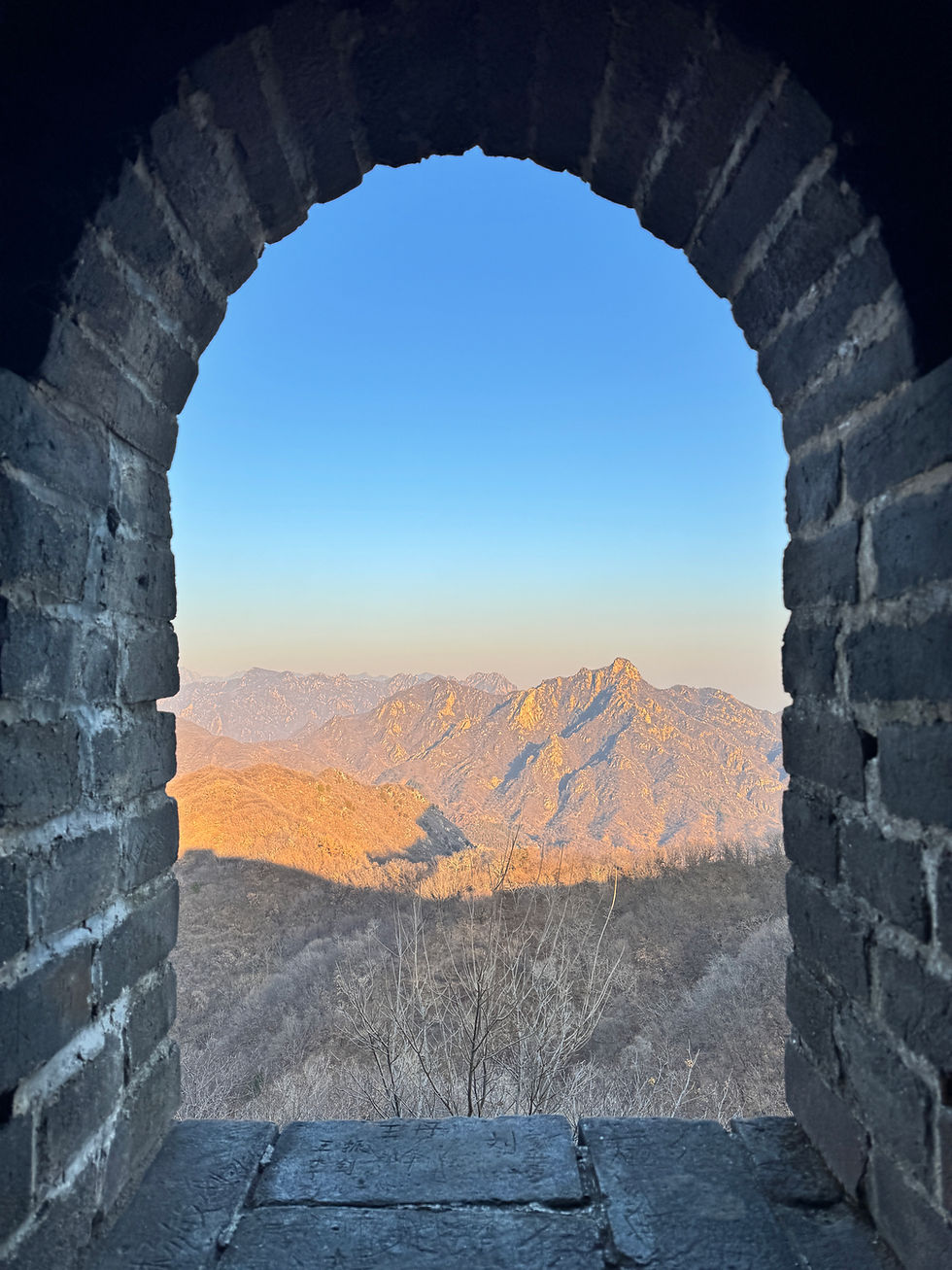
The views from the watchtowers are something else. Mountains rolling into the horizon. The Wall curving and disappearing into the mist. It's the kind of view that makes you feel very small and very grateful at the same time.
Practical Info:
Entrance fee: Around ¥40-45 (varies by section)
Cable car: Available at Mutianyu and Badaling (additional fee)
Time needed: Half day to full day depending on section and hiking level
What to wear: Comfortable hiking shoes (essential!), layers, sunscreen
What to bring: Water (there are limited options on the Wall), snacks, camera
Book tickets in advance: Especially during peak season
Traveler tip: Go early. The Wall opens around 7:30-8:00 AM depending on the section, and the first few hours before tour groups arrive are magical. The mist, the quiet, the sense of walking through history alone, it's worth the early alarm.
The Forbidden City & Tiananmen Square
If the Great Wall shows you China's power, the Forbidden City shows you its grandeur.
Tiananmen Square

Before entering the Forbidden City, you'll cross Tiananmen Square, one of the largest public squares in the world. It's massive, open, and historically significant. The square is flanked by the National Museum of China on the east side and the Great Hall of the People on the west side.
Walking across Tiananmen Square, surrounded by monumental architecture and the weight of history, is a sobering experience. It's the kind of place where you don't need a tour guide to feel the significance.
The Forbidden City (Palace Museum)

And then you enter the Forbidden City.
For 500 years, this was the most exclusive address on Earth. Home to 24 emperors across the Ming and Qing dynasties. Nearly 10,000 rooms. 180 acres of palaces, courtyards, and gardens. And ordinary citizens? Forbidden from entering. Hence the name.
Walking through the Meridian Gate and into the first courtyard, the scale hits you immediately. Everything is enormous. The courtyards stretch wider than football fields. The halls tower overhead with golden roofs that gleam in the sunlight. The details, like carved dragons, marble balustrades, painted beams, are everywhere.
What to See:
The Outer Court: The three main halls along the central axis. The Hall of Supreme Harmony (the largest and most important), the Hall of Central Harmony, and the Hall of Preserving Harmony. This is where emperors conducted state affairs and held ceremonies.
The Inner Court: The Palace of Heavenly Purity, Hall of Union, and Palace of Earthly Tranquility. This was the emperor's private living quarters.
The Imperial Garden: At the northern end. A peaceful contrast to the overwhelming grandeur of the halls. Ancient cypress trees, rock formations, and pavilions.
The Clock Gallery and Treasure Gallery: Separate tickets (¥10 each) but absolutely worth it. The clock collection is stunning, and the treasure gallery holds some of the most exquisite jade, gold, and gemstone artifacts you'll ever see.
Pro Move: Jingshan Park
After exiting through the Gate of Divine Prowess (north exit), cross the street to Jingshan Park. Climb to the top of Wanchun Pavilion for the most spectacular panoramic view of the entire Forbidden City. Most of those sweeping aerial photos of the Forbidden City you've seen on social media? They're taken from here. Entry is only ¥10, and the view is priceless.
Practical Info:
Entrance fee: ¥60 (peak season, April-October), ¥40 (off-peak, November-March)
Closed on Mondays (except public holidays)
Tickets must be booked online in advance as you cannot buy them on-site
Book 7 days ahead at 8 PM Beijing time for guaranteed entry
One-way route: Enter from Meridian Gate (south), exit from Gate of Divine Prowess (north)
Time needed: 2-4 hours depending on pace
Bring your passport: Required for entry
Traveler tip: Arrive right at opening (8:30 AM) or after 2 PM when tour groups start leaving. The central axis gets packed between 10 AM and 1 PM. If you have time, rent an audio guide (¥40 for English). The stories behind each hall are fascinating and really bring the place to life.
National Museum of China

Located on the east side of Tiananmen Square, the National Museum of China is one of the largest museums in the world. And the best part? It's free.
The museum covers Chinese history from ancient times to the present, with an incredible collection of artifacts spanning thousands of years. Bronze vessels from the Shang Dynasty. Jade artifacts. Ancient pottery. Calligraphy. Modern art.
The "Ancient China" exhibition is the standout. It takes you chronologically through Chinese civilization, from prehistoric times through the Qing Dynasty. Even if you're not a museum person, the scale and quality of the collection is genuinely impressive.
Practical Info:
Entrance: Free (passport required)
Closed on Mondays
Time needed: 1.5-3 hours depending on interest
Book tickets online in advance via WeChat or the museum website
Traveler tip: Pair this with your Tiananmen Square and Forbidden City visit. The museum is right there, and it provides incredible context for everything you'll see at the Forbidden City afterward (or before).
Summer Palace

After the intensity of the Great Wall and the Forbidden City, the Summer Palace feels like a deep breath.
Located about 15 km northwest of central Beijing, the Summer Palace was the imperial family's escape from the heat and formality of the Forbidden City. Built in the 18th century and expanded by the legendary Empress Dowager Cixi, it's a sprawling complex of palaces, gardens, temples, and a massive lake, covering about 300 hectares, three-quarters of which is water.
And it's gorgeous.
What to See:
Kunming Lake: The heart of the Summer Palace. You can take a boat across it, walk around it, or just sit and watch the reflections of ancient pavilions on the water. The lake was modeled after Hangzhou's famous West Lake (and having been to Hangzhou, I can see the resemblance).
The Long Corridor: A 728-meter covered walkway along the lakeside, decorated with over 14,000 paintings depicting scenes from Chinese history, mythology, and nature. It's considered the longest of its kind in the world. You could spend an hour just examining the artwork.
Longevity Hill: Climb to the Tower of the Fragrance of Buddha for panoramic views over the entire palace complex and Kunming Lake. The climb is steep but worth every step.
The Seventeen-Arch Bridge: Connecting the lakeshore to South Lake Island. It's 150 meters long with 17 arches and beautifully carved stone lions. Around the Winter Solstice, the setting sun shines through all 17 arches, a phenomenon known as the "Golden Light" that photographers travel specifically to capture.
The Marble Boat: A 36-meter marble pavilion shaped like a boat, built at the edge of the lake. It can't sail, obviously, but it's one of the most photographed spots in the complex.
Suzhou Street: A recreated canal-side market street where emperors and their consorts would pretend to be ordinary people "shopping", served by palace eunuchs playing the role of merchants. It's charming, quirky, and a fascinating window into imperial life.
Practical Info:
Entrance fee: ¥60 (peak season), ¥50 (off-peak). Combined ticket including scenic spots inside: ¥70/50
Open daily (some internal buildings closed on Mondays)
Time needed: Half day (2-4 hours minimum)
Getting there: Subway Line 4 to Beigongmen Station, then a short walk to the North Gate
Traveler tip: The Summer Palace is huge. Wear comfortable shoes and allocate at least half a day. Start early to avoid afternoon crowds. The lakeside areas get packed, but if you climb Longevity Hill or explore the western sections, the crowds thin out dramatically.
Temple of Heaven

The Temple of Heaven is where emperors of the Ming and Qing dynasties performed sacred rituals, praying to heaven for good harvests. Built in 1420, the same year as the Forbidden City, the complex is actually larger than the Forbidden City itself.
Why It's Worth Visiting:
The Hall of Prayer for Good Harvests: The iconic circular, triple-roofed building you've seen in every Beijing photo. It was built entirely of wood (no nails) and its design is based on the number nine, considered the supreme imperial number.
The Echo Wall: A circular wall around the Imperial Vault of Heaven that transmits sound waves. You can whisper at one end and someone at the other end can hear you clearly. Ancient acoustic engineering at its finest.
The Circular Mound Altar: An open-air marble platform with three tiers, where the Winter Solstice ceremony took place. Stand on the center stone and speak, and your voice resonates dramatically due to the circular design.
The Park Atmosphere: Beyond the historical buildings, the park around the Temple of Heaven is famous for local life. Early mornings, you'll find elderly Beijingers practicing tai chi, dancing, playing traditional instruments, and doing group exercises. It's one of the most authentic local experiences in Beijing.
Practical Info:
Entrance fee: ¥35 (combined ticket, peak season), ¥30 (off-peak)
Open daily (internal buildings closed on Mondays)
Time needed: 2-3 hours
Getting there: Subway Line 5 to Tiantan Dongmen Station
Traveler tip: Visit early morning (7-9 AM) to catch locals doing their morning routines. It's a side of Beijing that most tourists miss, and it's incredibly special.
Beijing Food Highlights: The Peking Duck Experience

Let's talk about the real reason half the world visits Beijing. Peking duck.
I'd had duck before. I'd had good duck before. But Peking duck in Beijing? That's a completely different experience.
What is Peking Duck?
Peking duck is Beijing's most iconic dish, with a history dating back to imperial China. The duck is roasted to achieve incredibly crispy, lacquered skin and tender, juicy meat. It's traditionally served in stages:
First, the skin: Thin, crispy, golden-brown slices dipped in sugar. This is the star. The skin practically melts.
Then the meat: Tender slices served with thin pancakes, scallion strips, cucumber, and sweet bean sauce (hoisin). You wrap it all together into a small roll and eat it in one or two bites.
Finally, the bones: Many restaurants will make a soup from the duck bones, served at the end of the meal. Rich, warming, and the perfect finale.
Watching the chef carve the duck tableside is part of the experience. It's ceremonial. Precise. Every slice is intentional.

Where to Eat Peking Duck in Beijing:
Siji Minfu (四季民福): One of the most popular among locals and visitors. Great quality-to-price ratio. The branch near the Forbidden City is famous for its views of the palace moat. Expect queues of 1-2 hours during peak times, so get there early or get a number and come back.
Da Dong (大董): The upscale option. Known for its signature "crispy but not greasy" style with extremely thin, delicate skin. Michelin-starred. Beautiful presentation. Higher price point but worth it for a special occasion.
Quanjude (全聚德): The historic institution, established in 1864. Over 160 years of roasting duck. More touristy but still serves quality duck. The Qianmen flagship is the most famous location.
Bianyifang (便宜坊): One of Beijing's oldest duck restaurants (over 600 years!). Uses a different roasting method (closed oven) that produces juicier, more tender meat with a lighter flavor.
Hua's Restaurant (花家怡园): Traditional Beijing courtyard setting with great food. The courtyard branch is especially atmospheric at night with lanterns and traditional decor.
Other Beijing Foods to Try:
Zhajiangmian (炸酱面): Beijing-style noodles with soybean paste sauce. Hearty, savory, and comforting.
Jianbing (煎饼): Beijing's beloved street breakfast crepe. Crispy, savory, and addictive.
Beijing Yogurt (北京酸奶): Thick, slightly sweet yogurt served in a ceramic pot. Find it near tourist sites.
Hot Pot: Beijing-style hot pot (涮羊肉) features thinly sliced lamb in a copper pot. Different from Sichuan hot pot but equally satisfying.
Traditional Beijing Snacks: Explore Wangfujing Snack Street or Nanluoguxiang for a variety of local treats.
Traveler tip: For Peking duck, don't just walk in expecting a table. Most popular restaurants require you to get a queue number and wait, sometimes 2-3 hours. Arrive before 5 PM for dinner or plan lunch around 11 AM. Some restaurants accept reservations via Dianping or Meituan (Chinese apps), so ask your hotel to help book ahead.
Where to Stay in Beijing

Beijing is a big city, so location matters. Here are the best areas for tourists:
The best base for first-time visitors. Close to the Forbidden City, Tiananmen Square, Wangfujing shopping street, and excellent subway connections. Most major attractions are within easy reach.
Close to the Forbidden City's western side and traditional hutong neighborhoods. Great for those wanting a more local, residential feel.
Beijing's modern business and nightlife district. Home to the CBD, embassies, Sanlitun bar street, and many international hotels. Best for business travelers or those wanting a more cosmopolitan experience.
Walking distance to the Forbidden City, excellent dining (including Peking duck restaurants), and major subway lines.
Practical Tips for Beijing

Language:
English is less widely spoken in Beijing compared to Shanghai. Google Translate (with the camera function for Chinese characters) is essential. Download offline Chinese language packs before you arrive. Many signs at tourist attractions have English translations.
Internet & VPN:
Many international apps and websites (Google, Instagram, WhatsApp, YouTube) are blocked in China. Download a reliable VPN before arriving. WeChat is China's everything app: messaging, payment, restaurant reservations, and taxi booking.
Payment:
WeChat Pay and Alipay are used almost everywhere. Cash is accepted but increasingly rare. Set up your international payment method before arriving. Some smaller vendors may only accept mobile payment.
Visa:
China has been expanding visa-free policies. As of recent updates, citizens from many countries can transit through Beijing visa-free for up to 144 hours (6 days). Citizens of some countries enjoy 30-day visa-free stays. Check the latest visa requirements for your nationality before traveling.
Air Quality:
Beijing's air quality varies. Check the AQI (Air Quality Index) before outdoor activities. Consider bringing a mask for high-pollution days. Winter tends to have more haze; autumn is usually the clearest.
Transportation Card:
Get a Yikatong transportation card for the subway and buses. Available at subway stations with a refundable deposit.
Temple & Palace Etiquette:
No smoking inside historical sites
Follow one-way routes at the Forbidden City
Don't touch or lean on artifacts
Photography restrictions apply in some areas (watch for signs!)
Be respectful and keep voices down
Dress Code:
Comfortable walking shoes (you'll average 15,000-25,000 steps per day in Beijing)
Layers for unpredictable weather
Sun protection in summer
Warm jacket, hat, and gloves in winter
Sample Beijing Itinerary

Day 1: The Forbidden City & Central Beijing
Morning: Tiananmen Square (early morning)
Mid-morning: Forbidden City (arrive at opening, 8:30 AM)
Early afternoon: Jingshan Park for panoramic Forbidden City views
Afternoon: National Museum of China
Evening: Peking duck dinner
Day 2: The Great Wall
Full day: Great Wall excursion (allow 1.5-2 hours travel each way)
Morning: Arrive early for the best experience with fewer crowds
Afternoon: Hike the Wall, explore watchtowers, take in the views
Evening: Return to Beijing, rest
Day 3: Summer Palace & Temple of Heaven
Morning: Temple of Heaven (arrive early for local morning routines)
Afternoon: Summer Palace (boat ride, Long Corridor, Longevity Hill)
Evening: Explore hutong neighborhoods, try local street food
Day 4: Explore & Departure
Morning: Wangfujing shopping street or Nanluoguxiang hutong area
Afternoon: Any attractions you missed, souvenir shopping
Evening: Final Peking duck dinner (you'll want a second round, trust me)
Beijing Travel FAQs

How many days do you need in Beijing?
3-4 days is ideal for first-time visitors. This gives you time for the Great Wall, Forbidden City, Summer Palace, Temple of Heaven, and plenty of Peking duck. 5+ days allows for a more relaxed pace and deeper exploration of hutong neighborhoods, additional Great Wall sections, and day trips.
Is Beijing worth visiting?
Absolutely. Beijing is one of those cities that changes your perspective. The scale of history, the food, the contrast between ancient and modern, it's just unlike anywhere else. If you're visiting China, Beijing should be at the top of your list.
Is Beijing expensive?
Compared to Dubai or most European cities, Beijing is quite affordable. Street food can cost as little as ¥10-20, a good Peking duck meal is ¥150-300 per person, and attraction tickets are very reasonable (most under ¥100). Hotels range from budget to luxury.
Is Beijing safe?
Very safe. Beijing has extremely low crime rates. The biggest "risks" are scam artists near tourist sites (people approaching you for "tea ceremonies" or "art exhibits" are common scams, so just politely decline).
Can I visit the Forbidden City and Great Wall in one day?
Technically possible but not recommended. Both deserve at least half a day each. The Great Wall requires significant travel time. Give each its own day for the best experience.
Do I need to speak Chinese in Beijing?
Not necessarily, but it helps. English is limited. Download translation apps and learn basic phrases. Hotel staff at international hotels typically speak English.
What's the best way to get to the Great Wall from Beijing?
Options include private car/driver (most convenient), organized tour groups, public bus, or high-speed train (to Badaling only). For Mutianyu and other sections, a private car or tour is usually the best option.
Is the Forbidden City really that big?
Yes. It's massive! 180 acres with nearly 10,000 rooms. Even a quick walk along the central axis takes 1.5-2 hours. A thorough visit takes 3-4 hours.
So, Is Beijing Worth the Hype?

Beijing surprised me in a way few cities have. It isn’t just a destination. It’s centuries of history layered into every street, palace, and mountain view.
You can walk the same courtyards emperors once ruled from. You can stand on a wall that stretches across mountains like a dragon guarding a civilization. And you can sit down to a meal that chefs have perfected for generations.
Shanghai is electric. Hangzhou is poetic. Zhangjiajie is surreal.
But Beijing?
Beijing is powerful.
If China is on your travel list, start here.
Go. Walk the Wall. Stand in the Forbidden City. Eat the duck. And you'll understand why Beijing has been the center of an empire for over 800 years. It earns it. Every single day.
Have you been to Beijing? What was your favorite moment? Drop a comment below!


Comments