


Zhangjiajie: The Most Otherworldly Place I've Ever Been (Travel Guide)

Updated: Feb 20
There are places that look exactly like their photos. And then there's Zhangjiajie.
I'd seen the pictures. The towering sandstone pillars. The mist-shrouded peaks. The glass bridge suspended 300 meters above a canyon. I thought I knew what to expect.
I was wrong.
Because standing in Zhangjiajie National Forest Park, surrounded by ancient rock formations formed hundreds of millions of years ago that look like they're floating, you realize something: Earth can look like another planet. And no photo, no video, no amount of preparation can capture what it feels like to be there.
If you've ever watched Avatar and thought "I wish places like that actually existed," let me tell you something: they do. And Zhangjiajie is the real-world inspiration behind them.
This is my complete guide to one of the most otherworldly places I've ever been.
Here’s your roadmap:
Getting to Zhangjiajie

Zhangjiajie is located in Hunan Province in central China. While it's not as easily accessible as Beijing or Shanghai, getting there is straightforward.
By Air: Zhangjiajie Hehua International Airport (DYG) has direct flights from major Chinese cities:
Beijing (2.5 hours)
Shanghai (2 hours)
Guangzhou (1.5 hours)
Chengdu (1.5 hours)
International travelers typically fly into one of these major hubs first, then take a domestic flight to Zhangjiajie.
By Train: High-speed trains connect Zhangjiajie to major cities. The journey from:
Changsha: ~3 hours
Guangzhou: ~5-6 hours
Beijing: ~12 hours
Getting Around: Once in Zhangjiajie, you'll need transportation to the various scenic areas:
Taxis/Didi: Available but negotiate prices beforehand
Tour buses: Most convenient option for accessing multiple sites
Organized tours: Highly recommended (more on this below)
Traveler tip: I visited with Trekkup, and having an organized tour made a massive difference. They handled all transportation, tickets, and logistics, which meant I could just focus on experiencing the place. Highly recommend if you want a stress-free trip.
When to Visit Zhangjiajie
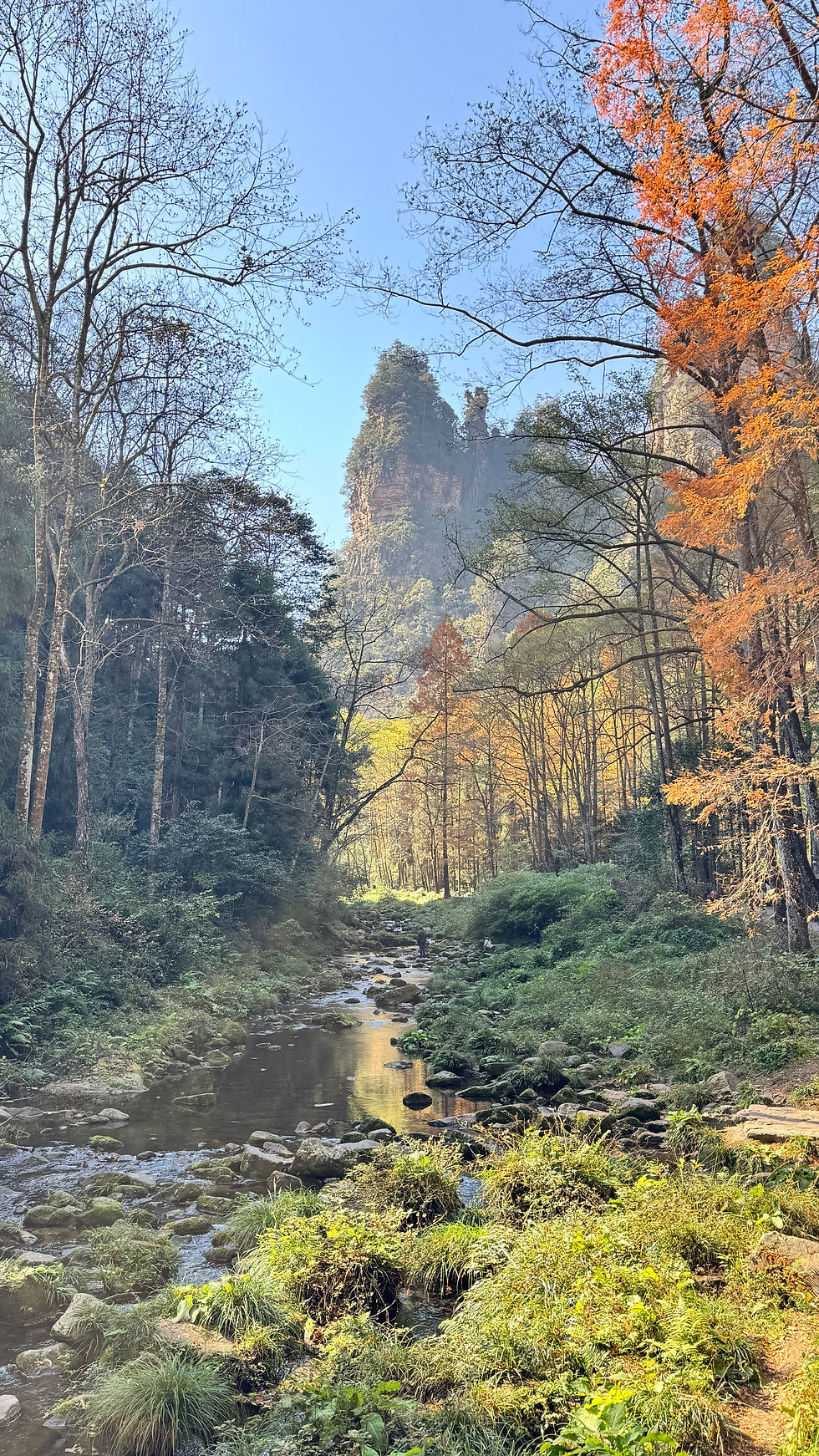
Zhangjiajie is beautiful year-round, but each season offers something different:
Spring (March-May):
Mild temperatures (15-25°C)
Flowers blooming
Occasional rain creates dramatic mist
Popular season, moderate crowds
Summer (June-August):
Warmest season (25-35°C)
Lush green vegetation
Peak tourist season, expect crowds
Afternoon thunderstorms common
Autumn (September-November):
Best weather (15-25°C, clear skies)
Fall foliage creates stunning colors
Less crowded than summer
Recommended season for photography
Winter (December-February):
Cold (0-10°C)
Possibility of snow on peaks (magical!)
Fewer tourists
Some attractions may have reduced hours
Avoid if possible: Chinese national holidays (Golden Week in early October, Chinese New Year) when crowds are intense.
Day-by-Day: My Zhangjiajie Adventure
Day 1: Arrival

I flew into Zhangjiajie from Shanghai in the evening. About two hours in the air, then straight to my hotel.
I checked in, unpacked my gear, looked at the itinerary for the next day, and tried to mentally prepare for what was coming.
Spoiler: I wasn't prepared.
Day 2: Zhangjiajie National Forest Park - Huangshizhai & Golden Whip Stream
Morning: Huangshizhai

We started early, taking a cable car up to Huangshizhai. And the moment we emerged above the treeline, I understood why people travel across the world for this.
Towering sandstone pillars rose from the mist like something out of a fantasy novel. These ancient rock formations, over 300 million years old, are called the "Avatar Mountains" for a reason. These aren't just hills or peaks. They're vertical columns of rock, some over 200 meters tall, covered in vegetation, surrounded by clouds.
We hiked down from Huangshizhai, which took about 2-3 hours. The trail winds through forest, past viewpoints, and offers constantly changing perspectives of the pillars. My legs were burning, but I couldn't stop taking photos.
Afternoon: Golden Whip Stream

After lunch, we explored Golden Whip Stream. This is the complete opposite of the dramatic mountain peaks. It's serene, peaceful, almost meditative.
The stream flows between towering cliffs, the water is crystal clear, and the trail is flat and easy. We walked for about 2 hours, just taking it in. Monkeys occasionally appeared (keep your snacks hidden!), and the sound of water echoing off the canyon walls was incredibly calming.
Traveler tip: Wear comfortable hiking shoes. You'll be walking 10,000+ steps easily.
Day 3: Yuanjiajie, Tianzi Mountain & Ten-Mile Gallery
This was the day I'd been waiting for. Avatar day.
Morning: Bailong Elevator to Yuanjiajie

The Bailong Elevator is an engineering marvel. It's built into the side of a cliff and shoots you up 326 meters in less than two minutes. My stomach didn't catch up until we reached the top.
And then... Yuanjiajie.
This is what inspired the floating Hallelujah Mountains in Avatar. These towering rock formations inspired the film's visual design, and Zhangjiajie has since been officially associated with Avatar's otherworldly landscape. Standing among these pillars, mist swirling around them, I finally understood why.
There's one pillar called "Avatar Hallelujah Mountain" (officially renamed after the movie in 2010). It towers dramatically above the valley floor, rising over a kilometer in elevation when measured from base to summit, and yes, it looks like it's floating when the mist is right.
Afternoon: Tianzi Mountain

We hiked from Yuanjiajie to Tianzi Mountain. This hike takes 2-3 hours and offers some of the most stunning views in the entire park.
Mist-shrouded cliffs. Lush valleys. Dense forests. Fragrant flowers. And those bizarre, beautiful rock formations everywhere. It's a natural art gallery.
The Ten-Mile Gallery was next. This is a valley with about 200 rock formations that supposedly resemble human figures and animals. Some are more convincing than others, but the landscape itself is worth it.
Traveler tip: Start early. The mist is usually thickest in the morning, which creates the most dramatic photos.
Day 4: Zhangjiajie Grand Canyon Glass Bridge & Huanglong Cave
Morning: The Glass Bridge

Let me be very clear about this: I am not afraid of heights.
But standing on a 430-meter-long glass bridge, suspended 300 meters above a canyon floor, looking straight down through transparent glass? My legs physically refused to move for a solid 30 seconds.
This is one of the world's longest and highest glass-bottomed bridges. It's 6 meters wide, and yes, every step feels terrifying. There's a bungee jumping platform in the center if you're truly insane.
But here's the thing: once you get moving, once you stop looking down, the views are incredible. Mountains surrounding you on all sides, the canyon stretching below, the sense of floating in mid-air.
Would I do it again? Ask me when my heart rate returns to normal.
Afternoon: Huanglong Cave

After the glass bridge, we descended into Huanglong Cave. And this was a completely different experience.
Huanglong Cave is one of China's largest karst caves, with massive chambers, underground rivers, and rock formations that have been growing for millions of years.
We walked through lit pathways, past towering stalagmites, under stone "waterfalls" frozen in time, and across underground rivers. At one point, we took a boat through a subterranean lake. It felt like entering another world beneath the mountains.
The cave maintains a cool temperature around 16°C year-round, so bring a light jacket.
Day 5: Baofeng Lake & Tianmen Mountain
Our final day in Zhangjiajie.
Morning: Baofeng Lake

Baofeng Lake is tucked in a valley, surrounded by limestone cliffs and lush forest. We took a boat across the emerald-green water, and local singers performed traditional folk songs that echoed off the canyon walls.
It was peaceful. Serene. A perfect counterbalance to the intensity of the previous days.
Afternoon: Tianmen Mountain

Important note: Tianmen Mountain is a separate scenic area from Zhangjiajie National Forest Park, located south of the main park, and requires its own ticket.
We saved Tianmen Mountain for last, and honestly, it might have been my favorite.
The cable car to the summit is one of the longest in the world (about 7.5 kilometers), and the ascent takes about 25-30 minutes. You glide over forests, villages, and eventually straight up the mountain face.
At the top, there are walking paths, viewpoints, and the famous "Heaven's Gate" (a natural arch through the mountain). The views from the summit? Absolutely unforgettable.
Saying goodbye to Zhangjiajie was harder than I expected.
The Chinese Tea Ceremony: An Unexpected Highlight

During our trip, we participated in a traditional Chinese tea ceremony. And honestly, it was one of the most peaceful, grounding experiences of the entire journey.
In China, tea isn't just a beverage. It's medicine. It's culture. It's ritual. It's connection.
The ceremony itself is slow and deliberate. Water is heated to a specific temperature (different for green, black, or oolong teas). Tea leaves are rinsed, then steeped for precise amounts of time. Each cup is small, meant to be sipped slowly, mindfully.
Our guide explained that traditional Chinese medicine views tea as having healing properties. Green tea for clarity and energy. Pu-erh for digestion. Chrysanthemum for calming.
But beyond the health benefits, there's something about the ceremony itself that's meditative. The focus. The silence. The ritual of pouring, sipping, appreciating.
After days of hiking, climbing, and crossing terrifying glass bridges, sitting quietly with a cup of tea felt like exactly what I needed.
Practical Tips for Visiting Zhangjiajie

What to Pack:
Comfortable hiking shoes (essential!)
Light layers (temperature changes with elevation)
Rain jacket (weather can change quickly)
Sunscreen and hat
Refillable water bottle
Snacks (food options inside parks are limited)
Tickets & Passes:
Zhangjiajie National Forest Park offers multi-day passes (typically 2, 3, or 4 days) that include eco-bus transportation within the park
Zhangjiajie Grand Canyon Glass Bridge requires a separate ticket (not included in Forest Park pass)
Tianmen Mountain is a separate scenic area and requires its own ticket
Book in advance during peak season, especially for the Glass Bridge
Physical Fitness:
Moderate fitness level required
Expect 10,000-20,000 steps per day
Stairs and inclines common
Cable cars and elevators available for most ascents
Language:
English is very limited
Translation apps essential
Organized tours provide English-speaking guides
Cash vs. Card:
WeChat Pay and Alipay are widely used
Cash accepted but not always preferred
Have small bills for vendors
Sample 5-Day Zhangjiajie Itinerary with Trekkup

Day 1: Arrive, rest, prepare
Day 2: Zhangjiajie National Forest Park
Morning: Huangshizhai (cable car up, hike down)
Afternoon: Golden Whip Stream
Day 3: Avatar Mountains
Morning: Bailong Elevator → Yuanjiajie
Afternoon: Tianzi Mountain → Ten-Mile Gallery
Day 4: Canyons & Caves
Morning: Zhangjiajie Grand Canyon Glass Bridge
Afternoon: Huanglong Cave
Day 5: Final Highlights
Morning: Baofeng Lake
Afternoon: Tianmen Mountain
Evening: Depart
Zhangjiajie Travel FAQs

How many days do you need in Zhangjiajie?
4-5 days is ideal. 3 days minimum to see the major highlights. More time allows for a relaxed pace and hidden gems.
Is Zhangjiajie worth visiting?
Absolutely. If you want landscapes unlike anywhere else on Earth, Zhangjiajie delivers. It's one of the most unique places I've ever been.
Is Zhangjiajie really like Avatar?
Yes, the Yuanjiajie area directly inspired the floating mountains in Avatar. These rock formations became the design blueprint for Pandora's floating peaks, and Zhangjiajie has been officially associated with the film's visual inspiration. While Avatar wasn't physically filmed here, the resemblance is striking, especially when mist surrounds the pillars.
How difficult is the hiking?
Moderate. Most major viewpoints are accessible via cable cars/elevators. Hiking is optional but rewarding. Daily step counts of 10,000-20,000 are common.
Is the glass bridge safe?
Yes, extremely safe. It's engineered to support hundreds of visitors at once and has undergone rigorous safety testing. That said, it's terrifying if you're afraid of heights.
What's the best time to visit Zhangjiajie?
Autumn (September-November) offers the best weather and fewer crowds. Spring is also beautiful. Avoid peak Chinese holidays.
Do I need a tour guide?
Highly recommended. Navigating transportation, tickets, and language barriers is much easier with a guide. I went with Trekkup and it made the trip seamless.
Can I visit Zhangjiajie in winter?
Yes! Snow-covered pillars are magical. Just dress warmly and be prepared for some attractions to have reduced hours.
How do I get to Zhangjiajie from Beijing/Shanghai?
Fly directly (2-2.5 hours) or take a high-speed train (longer but scenic). Flying is faster and more convenient.
So, Is Zhangjiajie Really the Most Otherworldly Place I've Ever Been?

Yes.
And I don't say that lightly.
I've been to a lot of places. Cities, mountains, beaches, temples. But Zhangjiajie? It's different.
It's not just that the landscapes are stunning (though they absolutely are). It's that they don't look like anything else on Earth. These aren't mountains. They're pillars. Columns. Towers of ancient rock rising impossibly high, covered in green, shrouded in mist.
Standing in Yuanjiajie, surrounded by those formations, I felt like I was on Pandora. Like I'd stepped through a portal into another world.
And that's not even counting the glass bridge that made my legs shake, or the underground cave system that felt like descending into the underworld, or the serene tea ceremony that grounded me after days of adventure.
Zhangjiajie is worth the journey. The flights, the trains, the language barriers, the crowds. All of it.
Because there are very few places left on Earth that genuinely surprise you. That make you stop, stare, and think "how is this real?"
Zhangjiajie is one of them.
If you're planning a trip to China, put this on your list. Right at the top.
Trust me. You won't forget it.
Have you been to Zhangjiajie? What was your favorite part? Drop a comment below!
Special thanks to Trekkup for organizing this incredible adventure! Check them out if you're planning your own Zhangjiajie trip: https://www.meetup.com/trekkup/
(Note: Trekkup is one example of organized tour providers; similar services are available from multiple operators in the region.)


Comments