


Is Kyoto the Most Beautiful City in Japan? Here's My Honest Take

Updated: Feb 20
Here's the thing about Kyoto: everyone tells you it's beautiful. Everyone tells you it's where "old Japan" lives. Everyone tells you that if Tokyo is Japan's heartbeat, Kyoto is its soul.
And I'll be honest, I went in skeptical. Because how many times can you hear "you HAVE to see Kyoto" before you start thinking it's overhyped?
But then I spent two days walking through bamboo forests that felt otherworldly, standing in front of golden temples that literally glow, wandering narrow alleys where geishas still walk at dusk, and eating at a 400-year-old market that's somehow still thriving.
So is Kyoto the most beautiful city in Japan?
Here's my honest take: Yes. But not in the way you think. Let's break it down.
In this guide:
Getting to Kyoto

Kyoto is incredibly easy to reach from major Japanese cities:
From Tokyo: Shinkansen (bullet train) takes about 2 hours 15 minutes. It's fast, comfortable, and the views of Mount Fuji (on a clear day) along the way are worth it.
From Osaka: Only 30-45 minutes by train. Many travelers base themselves in Osaka and day-trip to Kyoto, but honestly? Stay in Kyoto. The city at dawn and dusk is magical.
International travelers:
Fly into either:
Kansai International Airport (KIX) in Osaka - closest to Kyoto (75-90 min by train)
Narita (NRT) or Haneda (HND) in Tokyo - then take Shinkansen to Kyoto
Getting around Kyoto:
Kyoto is more compact than Tokyo, and most major sites are accessible by:
Bus: Extensive bus network
Subway: Two lines, limited but useful
Bicycle: Many hotels and shops rent bikes. Kyoto is fairly flat and bike-friendly
Walking: Some districts (like Gion) are best explored on foot
Traveler tip: Use a Suica/PASMO/ICOCA card for tap-and-go fares. If you plan on lots of rides, consider the Kyoto Subway & Bus 1-Day Pass (¥1,100) (coverage depends on routes).
When to Visit Kyoto

Kyoto is stunning year-round, but the crowds and seasons vary dramatically:
Spring (March-May): Cherry blossom season. Absolutely gorgeous, absolutely packed. Book months in advance.
Summer (June-August): Hot and humid. June is the rainy season. But summer festivals (like Gion Matsuri in July) are incredible.
Autumn (September-November): Peak fall foliage season. Temples surrounded by red and gold maple trees. Second busiest season after spring.
Winter (December-February): Cold but clear. Fewer tourists, snow-dusted temples, beautiful winter illuminations. Underrated season.
Avoid if possible: Golden Week (late April/early May), Obon (mid-August), and peak cherry blossom/autumn weekends.
Day 1: Markets, Geishas, and Hidden Alleyways
Nishiki Market

Nishiki Market is a 400-year-old covered market that stretches for five blocks through central Kyoto. Locals call it "Kyoto's Kitchen," and once you walk through, you'll understand why.
This isn't a tourist trap. It's where Kyoto residents actually shop for ingredients. You'll see vendors selling:
Fresh seafood (including live octopus)
Kyoto pickles (tsukemono), dozens of varieties
Matcha everything (tea, sweets, ice cream)
Fresh mochi being made by hand
Wagyu beef at small specialty shops (some of the best quality you'll find)
Yakitori skewers, tamagoyaki, takoyaki
Japanese knives, ceramics, tea sets
What to try:
Matcha soft serve
Freshly grilled seafood skewers
Wagyu beef samples (small shops offer tastings)
Kyoto-style pickles (they're tangy, crunchy, addictive)
Tamagoyaki (sweet rolled omelet)
Best time to visit: Morning (9-11 AM) when it's less crowded and vendors are at their freshest.
Geisha District: Gion

Let's talk about geishas. Because if you're visiting Kyoto, you need to understand what you're actually seeing.
What is a geisha?
Geisha (or geiko in Kyoto dialect) are traditional Japanese performing artists. They're trained in classical music, dance, conversation, and tea ceremony. They're not what Western media often portrays them as. They're highly skilled entertainers who spend years in rigorous training.
Young geishas-in-training are called maiko. This is the key difference: maiko are apprentices, typically in their teenage years, who are still learning the art. You can spot them by their elaborate, colorful kimono with long trailing obi (sash), distinctive hairstyles with hanging ornaments (kanzashi), white makeup, and the way they walk in tall wooden sandals (okobo).
Geiko, on the other hand, wear more subdued kimonos, simpler hairstyles (often wigs), and shorter obi. They've completed their training and are fully-fledged professionals.
What is a Gion?
Gion is Kyoto's most famous geisha district. Its lantern-lit streets are often associated with the film Memoirs of a Geisha, and walking these streets at dusk feels like stepping into that world.
The streets are narrow, lined with traditional wooden machiya houses, tea houses (ochaya), and high-end restaurants. If you're lucky, you might see a maiko walking quickly to an appointment, her kimono trailing, the click of her wooden sandals echoing on the stone streets.
Geisha etiquette:
Don't chase or grab them for photos. They're on their way to work.
Don't block their path
If you see one, a respectful nod is fine. A photo from a distance is okay. Following them is not.
Best areas to explore in Gion:
Hanami-koji Street
Shirakawa Canal area (especially beautiful at dusk)
Gion Tatsumi Bridge
Around Yasaka Shrine
Best time: Early evening (around 5-7 PM) when geishas are heading to appointments.
Pontocho Alley

As the sun sets, head to Pontocho Alley, one of Kyoto's most atmospheric dining streets.
Pontocho is a narrow alley that runs parallel to the Kamo River. It's lined with traditional restaurants, izakayas, and tea houses. Paper lanterns glow, wooden facades creak, and the smell of grilled yakitori fills the air.
Some restaurants have outdoor seating overlooking the river (called "yuka" in summer). It's incredibly romantic.
What to eat:
Yakitori
Kaiseki (traditional multi-course Japanese meal)
Wagyu hot pot (shabu-shabu or sukiyaki - Pontocho is famous for this!)
Okonomiyaki
Fresh river fish
Traveler tip: Many restaurants here are high-end and require reservations. But there are also casual spots. Walk the alley first, see what appeals to you, and don't be afraid to ask if they have space.
Day 2: Temples, Bamboo Forests, and Golden Pavilions
Day 2 is temple day. And trust me, you want to start early.
Arashiyama Bamboo Forest

The Arashiyama Bamboo Grove is one of those places that photos can't quite capture. Because it's not just about how it looks. It's about how it feels.
You walk through a path surrounded by towering bamboo stalks that sway and creak in the wind. The light filters through in this soft, green glow. It's quiet despite the tourists. It's peaceful in a way that's hard to describe.
Best time to visit: Early morning (7-8 AM) before the crowds arrive. Seriously, this makes all the difference.
Nearby:
Tenryu-ji Temple (beautiful Zen garden)
Togetsukyo Bridge
Monkey Park Iwatayama (if you want to hike and see wild monkeys with a view)
Getting there: Train from central Kyoto to Arashiyama Station (about 20-30 minutes).
Ninna-ji Temple

Ninna-ji is a UNESCO World Heritage Site and former imperial palace turned temple. It's less crowded than Kyoto's "big name" temples, which makes it even more special.
What makes Ninna-ji unique:
The five-story pagoda
Beautiful traditional gardens
Cherry trees (if you visit in spring)
A sense of tranquility that some of the busier temples lack
Admission: Grounds are generally free, but the Goten palace buildings are ¥800 (seasonal fees can apply during special periods).
Best time: Morning or late afternoon
Ryoan-ji Temple

Ryoan-ji is home to Japan's most famous Zen rock garden. And yes, it's just rocks and sand. But somehow, it's mesmerizing.
The garden consists of 15 rocks arranged in raked white gravel. No matter where you sit, you can only see 14 rocks at once. It's designed to encourage meditation and contemplation.
Sit on the wooden platform. Watch. Think. Or don't think. That's kind of the point.
Admission: ¥500
Traveler tip: The garden gets crowded midday. Early morning is best for quiet reflection.
Kinkaku-ji (The Golden Pavilion)
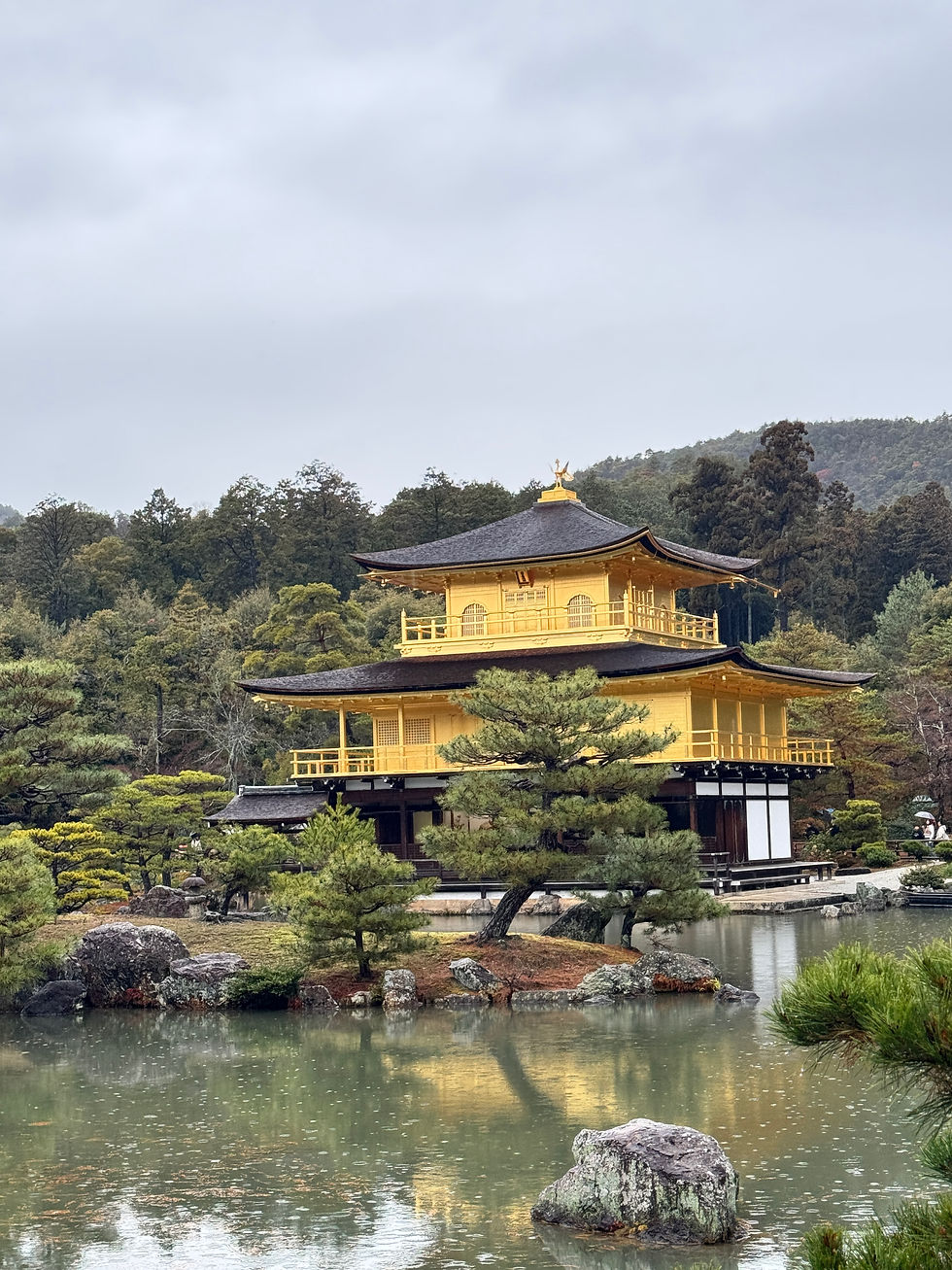
And then there's Kinkaku-ji. The Golden Pavilion.
This is the temple you've seen in every Japan photo ever. And when you see it in person, you understand why.
It's a three-story pavilion covered entirely in gold leaf, sitting on the edge of a mirror-like pond. On a clear day, the reflection is perfect. The gold glows. The surrounding trees frame it like a painting.
It's stunning. It's crowded. It's worth it.
History: The original pavilion was built in 1397. It burned down in 1950 (a monk set it on fire) and was rebuilt in 1955. The current gold leaf was reapplied in 1987.
Admission: ¥500
Best time: Early morning right when it opens (9 AM), or late afternoon when tour groups leave.
Traveler tip: The path is one-way, so you can't go back for another angle. Take your time at each viewpoint.
Yasaka Shrine (Evening)

After a full day of temples, end at Yasaka Shrine in the Gion district.
Yasaka Shrine is beautiful at dusk when the lanterns light up. It's one of Kyoto's most important shrines and hosts the famous Gion Matsuri festival every July.
The shrine is free to enter, and the atmosphere at night is magical. Locals come to pray, tourists wander through, and the whole area glows with warm light.
Bonus: After visiting the shrine, you're right back in Gion. Perfect for dinner.
Where to Stay: Sowaka Hotel (Gion District)

If you want to stay in the heart of Kyoto's most atmospheric district, Sowaka Hotel is perfect.
Located in Gion, one of Kyoto’s most cinematic, old-world neighborhoods, Sowaka is a boutique hotel that blends traditional Japanese design with modern luxury.
Why Sowaka:
Walking distance to Yasaka Shrine, Gion streets, Pontocho Alley
Traditional Japanese aesthetics with contemporary comfort
Intimate, quiet atmosphere
You're staying in the neighborhood where geishas still walk at dusk
Dining at Sowaka: Gion Loka Restaurant
The hotel's restaurant, Gion Loka, serves some of the best food I had in Kyoto.
Fresh sashimi: Every piece is incredibly fresh, beautifully presented, and has that melt-in-your-mouth quality that only the best Japanese restaurants can deliver. The fish is so good you'll understand why Kyoto is considered one of the world's sushi capitals.
A5 wagyu beef: This is where you experience A5 wagyu at its finest. The highest grade of Japanese beef, prized for its intricate marbling and buttery texture. It's so tender you barely need a knife, and it literally melts on your tongue. This is the kind of meal you don't forget.
Location perks: You can wake up early and explore Gion before the crowds. You can walk back to your hotel after dinner in Pontocho. You're in the heart of old Kyoto.
Kyoto Food Highlights

Kyoto has its own distinct cuisine (Kyo-ryori), known for being refined, seasonal, and beautifully presented.
Must-try Kyoto specialties:
Fresh sashimi: Kyoto's sashimi is world-class. Try it at Gion Loka or high-end restaurants in Gion
A5 wagyu beef: The highest grade Japanese beef. Find it at Gion Loka, specialty shops in Nishiki Market, or yakiniku restaurants
Wagyu hot pot: Pontocho Alley is famous for shabu-shabu and sukiyaki featuring premium wagyu
Kaiseki: Traditional multi-course meal. It's art on a plate.
Yudofu: Tofu hot pot (Kyoto is famous for tofu)
Matcha everything: Kyoto is green tea central. Matcha soft serve, matcha lattes, matcha desserts.
Kyoto-style pickles: Tangy, crunchy, surprisingly addictive
Obanzai: Kyoto-style home cooking (small seasonal dishes)
Where to eat:
Gion Loka (at Sowaka Hotel): Fresh sashimi and A5 wagyu beef
Nishiki Market: Street food, snacks, wagyu tastings, fresh ingredients
Pontocho Alley: Wagyu hot pot, yakitori, kaiseki, traditional restaurants
Gion: High-end dining, tea houses
Around temples: Small cafes with matcha desserts and traditional sweets
Traveler tip: Many traditional restaurants require reservations. If you want kaiseki or a tea house experience, book ahead.
Practical Tips for Kyoto

Temple etiquette:
Bow at torii gates before entering
Don't point at Buddha statues
Photography is usually allowed outside, often restricted inside
Speak quietly and be respectful
Dress code:
Wear comfortable walking shoes (you'll be walking a lot)
Modest clothing at temples (shoulders and knees covered)
Easy-to-remove shoes (many places require shoe removal)
Cash:
Many small restaurants, temples, and shops are cash-only
Have yen on hand
Crowds:
Popular temples (Kinkaku-ji, Fushimi Inari) are packed midday
Go early morning or late afternoon
Weekdays are better than weekends
Language:
English is less common than in Tokyo
Google Translate is your friend
Most temples have English signs
Sample 2-Day Kyoto Itinerary

Day 1: Central Kyoto & Gion
Morning: Nishiki Market (breakfast and shopping)
Midday: Explore central Kyoto (Nijo Castle, Imperial Palace)
Afternoon: Rest at hotel or cafe
Late afternoon/evening: Gion district walk (geisha spotting)
Dinner: Pontocho Alley
Day 2: Temples & Arashiyama
Early morning: Arashiyama Bamboo Forest (7-8 AM)
Late morning: Ninna-ji Temple
Midday: Ryoan-ji Temple (Zen rock garden)
Afternoon: Kinkaku-ji (Golden Pavilion)
Evening: Yasaka Shrine + Gion for dinner
Kyoto Travel FAQs

How many days do you need in Kyoto?
2-3 days is ideal for first-time visitors. You can cover major highlights (Kinkaku-ji, Arashiyama, Gion, Fushimi Inari) in 2 days, but 3-4 days allows for a more relaxed pace and hidden gems.
Is Kyoto better than Tokyo?
They're different experiences. Tokyo is modern, fast-paced, and high-energy. Kyoto is traditional, slower, and culturally rich. Most travelers visit both. If you only have time for one: Tokyo for urban energy, Kyoto for cultural immersion.
What is Kyoto most famous for?
Kyoto is famous for its temples (over 2,000), traditional geisha culture, bamboo forests, zen gardens, and being Japan's ancient capital for over 1,000 years. It's where traditional Japanese culture is most preserved.
Can you see geishas in Kyoto?
Yes, but they're called "geiko" in Kyoto. The best place to spot them is the Gion district, especially along Hanami-koji Street and near Yasaka Shrine around 5-7 PM when they're heading to appointments. Always be respectful and don't chase or block them.
Is 1 day enough for Kyoto?
One day is possible but rushed. You could hit 2-3 major sites (Kinkaku-ji, Arashiyama, Fushimi Inari) but you'd miss the atmosphere that makes Kyoto special. Budget at least 2 days if possible.
What's the best way to get around Kyoto?
Buses are the most comprehensive option. The Kyoto Subway & Bus 1-Day Pass (¥1,100) is great value if you're temple-hopping. Bicycles are perfect for exploring at your own pace. Central areas like Gion are best explored on foot.
How far is Kyoto from Tokyo?
About 2 hours 15 minutes by Shinkansen (bullet train). It's an easy day trip, though staying overnight is recommended to experience Kyoto at dawn and dusk.
When is the best time to visit Kyoto?
Spring (cherry blossoms, March-April) and autumn (fall foliage, November) are most beautiful but also most crowded. Winter (December-February) offers fewer tourists, clear skies, and peaceful temple visits. Avoid peak Golden Week (late April) and Obon (mid-August).
Do I need to speak Japanese in Kyoto?
No, but English is less common than in Tokyo. Major tourist sites have English signage. Google Translate's camera function is very helpful for menus. Learning basic phrases (hello, thank you, excuse me) goes a long way.
Is Kyoto expensive?
Kyoto can be pricey for accommodations during peak seasons. Temple admissions are affordable (¥300-¥500). Food ranges from budget-friendly (¥500-¥1,000) to high-end kaiseki (¥10,000+). Overall, similar pricing to Tokyo.
What should I wear in Kyoto?
Comfortable walking shoes are essential. Modest clothing at temples (shoulders and knees covered). Easy-to-remove shoes since you'll take them off frequently. Layers are smart year-round.
Can you do Kyoto in 2 days?
Yes! A well-planned 2-day itinerary can cover: Day 1 (Gion, Nishiki Market, Pontocho), Day 2 (Arashiyama Bamboo Forest, Kinkaku-ji, Fushimi Inari). You'll see the highlights but move quickly.
Is Kyoto safe for solo travelers?
Extremely safe. Japan has very low crime rates. Kyoto is safe day and night, even for solo female travelers. Normal travel precautions apply.
Do temples in Kyoto charge admission?
Most major temples charge ¥300-¥500 admission. Some shrines (like Yasaka Shrine and Fushimi Inari) are free. Budget about ¥2,000-¥3,000 for temple admissions if visiting 5-6 sites.
So, Is Kyoto the Most Beautiful City in Japan?

Here's my honest answer: Yes. But not because it has the most temples or the prettiest gardens or the most Instagram-worthy spots.
Kyoto is beautiful because it feels intentional. Every rock in a Zen garden is placed with meaning. Every street in Gion is preserved with care. Every bowl of matcha is whisked with precision.
Tokyo is alive, pulsing, and overwhelming. Kyoto is quiet, deliberate, and timeless.
In Tokyo, you feel the future of Japan. In Kyoto, you feel its past, present, and future all existing at once.
Is it the most beautiful city? Maybe. But more importantly, it's a city that makes you slow down. That makes you pay attention. That rewards curiosity and respect.
Walk through the bamboo forest at dawn. Stand in front of the Golden Pavilion at sunset. Watch a maiko disappear into a tea house at dusk.
And you'll understand why people can't stop coming back to Kyoto.
It's not just beautiful. It's unforgettable.
Have you been to Kyoto? What was your favorite moment? Drop a comment below!

Comments