


Costa Rica & Panama Canal 8-Day Itinerary: Cruise, Stops & Travel Tips

Most people think the Panama Canal is just a shortcut for cargo ships. I did it the hard way. Starting in the deepest jungles of Costa Rica and ending in the Atlantic Ocean, climbing 86 feet up a mountain of water with nothing but gravity.
This isn't your typical cruise. It's an expedition.

Here’s my complete Costa Rica & Panama Canal expedition guide, and everything you need to know:
Before I boarded, I had to Google "wet landing." Spoiler: your shoes stay wet for days. These small-ship expeditions focus on getting you off the boat and into the wild - Zodiac boats, jungle hikes, and snorkeling spots no cruise liner could reach.
We sailed aboard the National Geographic Quest from Puerto Caldera, Costa Rica into some of the most biodiverse wilderness on Earth. Eight days, two oceans, and a lot of muddy boots later, I understand why they call this "the hardest way to cross the Panama Canal."
Day 1: Wednesday, February 4 - Welcome Aboard in Puerto Caldera

Sunrise 0701 / Sunset 1845
Our journey began not at the dock, but at the Costa Rica Marriott Hacienda Belen, where Lindblad Expeditions hosted us in a hospitality room. I landed at San José airport around noon, cleared customs, and met the distinctive National Geographic-Lindblad team holding their branded signs.
The transfer departed at 3:30 p.m. sharp, arriving at the ship in Puerto Caldera at 5:00 p.m. for embarkation. By 6 p.m., we were sailing into the Pacific, leaving the mainland behind.
On behalf of Lindblad Expeditions-National Geographic, Captain Paul Figuenick, his officers and crew, and the expedition staff welcomed us aboard. We learned we'd be sailing through a truly remarkable region - a geologically young land bridge connecting two continents and separating two oceans.
During our journey through Costa Rica and Panama, we'd experience an extraordinary range of Neotropical ecosystems, from mangrove-lined rivers and rugged shorelines to lush tropical rainforests and vibrant coral reefs.
The Mission: Our days would be filled with adventure as we hike, swim, kayak, paddleboard, snorkel, and explore by Zodiac, discovering the natural and cultural richness of this region. We would visit places of deep cultural and historical significance, an expedition connecting nature, people, and purpose.
Pro tip: You cannot meet the ship at the dock independently, you must take the group transfer from the hospitality room. Plan your flights to land by 2:00 p.m. to make the 3:30 p.m. departure.
Time Zone Note: The National Geographic Quest operates on Panama time for the entire voyage. Before going to bed tonight, advance your clocks one hour ahead of Costa Rica time and turn off any automatic time settings on your devices.
Tonight, we departed Puerto Caldera and headed south toward the Osa Peninsula, covering more than 100 nautical miles overnight. While rough seas were not expected, some motion was possible.
Day 2: Thursday, February 5 - Punta Caletas & Corcovado National Park

We covered 106 nautical miles overnight and woke up anchored off the Osa Peninsula, home to some of the most pristine lowland rainforest on the Pacific coast. This is Corcovado National Park territory, the real deal.
The morning started with the Punta Caletas 1.5-mile Forest Hike — an interpretive walk with stops to learn about the ecosystem. The trail meandered through dense forest where the expedition team pointed out medicinal plants, strangler figs, and the subtle signs of wildlife most walkers would miss.
After repositioning to Corcovado, we experienced our first wet surf landing — jumping out of the Zodiac into shallow waves and scrambling up the beach. This is where the adventure really begins.

I chose the Long Faster Pace Trail through primary rainforest. The humidity hits you immediately, but so does the life — every surface covered in moss, ferns, and fungi. We spotted all four monkey species: howler, spider, squirrel, and capuchin. Scarlet macaws flew overhead, their feathers almost unnaturally red against the green canopy.
The afternoon brought a different kind of magic — strolling along black sandy beaches under almond trees absolutely loaded with macaws. The slower-paced beach walk offered plenty of time for photography and simply absorbing the wildness of this place.
Day 3: Friday, February 6 - Playa Blanca & The Heart of Costa Rica
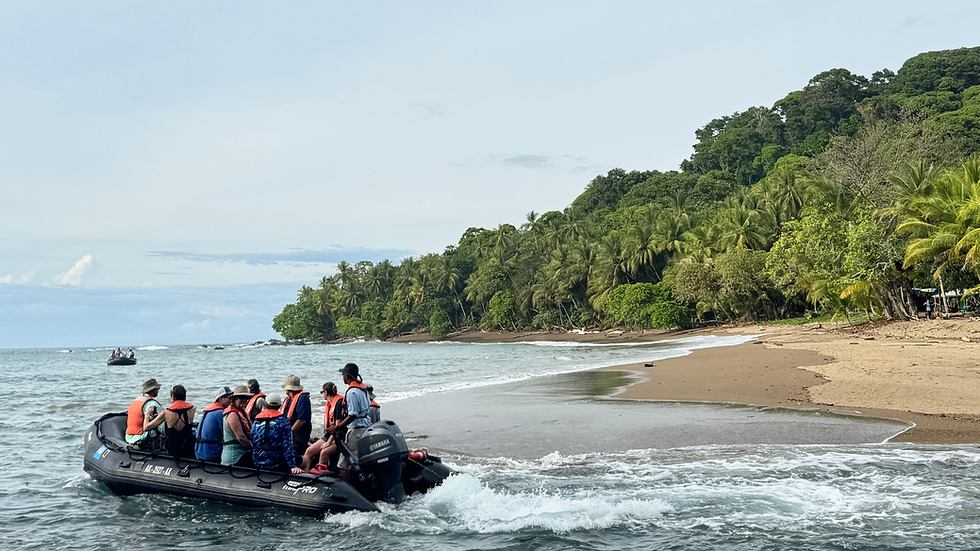
Wet landing at Playa Blanca base station, we waded ashore on the western side of Golfo Dulce and made our way to the base station, a rustic open-air pavilion that serves as headquarters for today's cultural immersion.
Mrs. Eida's Heart of Palm Plantation. A true pioneer of the region, Mrs. Eida was one of the original inhabitants of what is now Corcovado National Park. In exchange for her land within the park, she received property nearby, where she now cultivates hearts of palm and shares her knowledge along with her fresh, homemade recipes with visitors. We tasted hearts of palm prepared three ways and heard stories of life before the park's establishment.

The BBQ lunch on the beach was the best meal of the trip, grilled fish, plantains, and fresh tropical fruit served under a thatched shelter with the sound of waves nearby.
Afternoon activities:
Juan's Gold Panning. We journeyed deep into the peninsula to meet Juan, who once made a living panning for gold. Today, he shares his heritage with visitors as a way to protect their land through responsible tourism. We walked a gentle route leading down to a riverbed, then tried our hand at panning, standing creekside, swirling sediment in traditional wooden pans before returning uphill on a mild slope.
Noemi and Johnny's Sugar Cane Mill. Next we met Noemi and her husband Johnny, who learned the art of artisanal sugar cane production from Noemi's father, Don Carmen. They now sell their products to locals and even to the Quest! Their sugar cane syrup was served at breakfast the next morning, and knowing the hands that made it changed the experience entirely.

Later, we visited the Latin American Sea Turtles (LAST) Association and heard presentations from the researchers working to protect sea turtle populations. Their dedication is contagious!
Day 4: Saturday, February 7 - Río Seco & Golfito Panga Cruises

The morning started with the Río Seco 2.3-mile Long Aerobic Forest Hike at the Klochko family reserve. This was the most challenging hike of the trip — a true aerobic workout through mature rainforest with significant elevation changes. The trail climbed through primary forest where the canopy was so dense it felt like dusk at mid-morning. Bromeliads, heliconias, and orchids exploded with color against the verdant green. We pushed the pace and emerged sweaty and exhilarated.
After repositioning to Golfito, we explored by local boat (Panga Cruises) - two distinct excursions:
"Dolphins & Monkeys" at 1445

Cruising the mangrove channels, we spotted capuchin and squirrel monkeys in the treeline, plus a small pod of dolphins surfacing in the main channel.
"Macaws & Toucans" at 1615
The late afternoon light brought out the birds: golden-hooded and Cherrie's tanagers, yellow-throated toucans, fiery-billed aracaris, and parakeets of every color. The macaws returned to their roosts in pairs, their raucous calls filling the air as the sun set.
Kayaking was also available in the peaceful waters off Golfito, a quieter way to experience the coastline.
Day 5: Sunday, February 8 - Coiba National Park, Panama
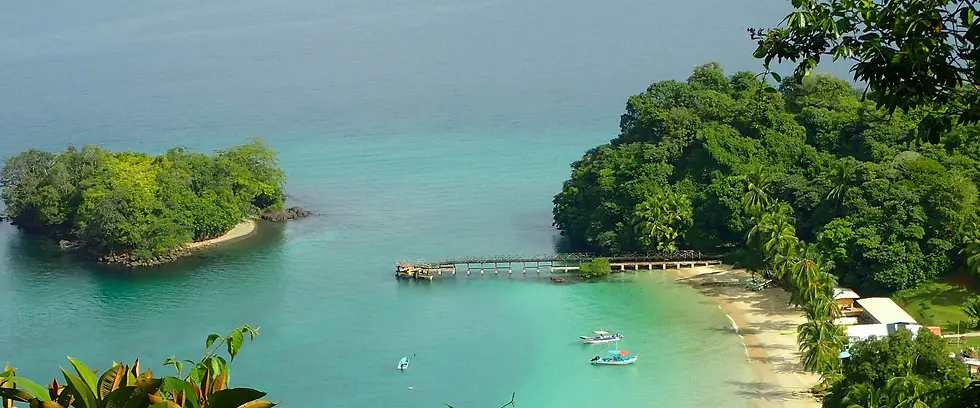
We traveled 123 nautical miles overnight and crossed into Panama, anchoring at the remote Isla Coiba, the first stop in a new country and a completely different vibe.
Coiba National Park is a UNESCO World Heritage site that used to be a notorious penal colony. Because it was off-limits for so long (accessible by special permit only), the nature here is completely untouched. The island has its own endemic species — the Coiba Island agouti and the mantled howler monkey plus four varieties of sea turtle.
I spent the morning snorkeling neighboring islets with visibility for days, discovering rich marine life around basalt reefs. Parrotfish, angelfish, and reef sharks cruised below while frigatebirds soared above.
The afternoon was pure bliss from kayaking to stand-up paddleboarding off a beach that looks like a screensaver, then just lying in the sand listening to howler monkeys in the distance. Some guests swam in the warm Pacific waters. No resorts. No roads. Just wild Pacific coastline.
Day 6: Monday, February 9 - Panama Canal Part 1: Sailing Through a Mountain

We traveled 219 nautical miles overnight from Coiba to reach the Panama Canal. The morning was spent at sea, and the expedition team screened "A Man, A Plan, A Canal, Panama" the David McCullough documentary that explains the impossible engineering before we witnessed it ourselves.
We arrived at the canal entrance in the afternoon. At 5:30 pm, we gathered on the sundeck for a cocktail hour with the Panama City skyline as our backdrop, a surreal moment of modern towers rising from tropical jungle, with massive cargo ships queuing nearby.
The Panama Canal Engineering Deep Dive:
Here's what nobody tells you: the locks are essentially giant water elevators. Because the center of Panama is mountainous, ships have to be lifted 86 feet above sea level to cross. No pumps. Just gravity. Millions of gallons of water pour into chambers the size of football fields, lifting our ship like a toy in a bathtub.
The concept is brilliant in its simplicity. The canal is essentially a water bridge - ships climb up one side, sail across the mountain range via Gatún Lake, then descend the other side. The gravity-fed lock system uses the natural flow of water from the Chagres River to fill and empty the chambers. Each transit uses approximately 52 million gallons of fresh water, enough to supply a city of 1 million people for a day.
The Culebra Cut (formerly Gaillard Cut) is where they sliced through the Continental Divide, a 9-mile trench through solid rock that cost thousands of lives and nearly bankrupted the project. When it opened in 1914, it instantly saved ships from 8,000 miles of sailing around Cape Horn. Today, it handles 14,000 ships annually, facilitating nearly 5% of global trade.
The timing: Cargo ships transit during daylight hours, so we began our crossing at night. We entered the Miraflores Locks after sunset, then the Pedro Miguel Locks, rising 86 feet in two stages. Watching the canal dramatically lit while massive steel gates close behind you? It's engineering on a scale that breaks your brain. We are literally climbing a continent.
Day 7: Tuesday, February 10 - Barro Colorado Island & The Atlantic Descent

By special arrangement, the National Geographic Quest anchored overnight in Gatún Lake near the Barro Colorado Nature Monument, right in the heart of the Panama Canal. This exclusive permit gave us an extra day to experience the engineering feat from the inside.
I chose the BCI Hike at the Smithsonian Tropical Research Institute facility on Barro Colorado Island. The expedition team warned us: this trail is basically a "Stairmaster in a Sauna." They weren't kidding.
The 2.5-hour hike covered 2 miles of rugged terrain, exposed roots, concrete steps, and humidity that hits you like a wall the second you step off the Zodiac. But the biodiversity is staggering: three-toed sloths, howler monkeys, agoutis, and countless birds. The research station itself feels like a place frozen in time, where scientists have been studying uninterrupted since 1923.

Other guests took a boat ride to the mouth of the Chagres River and hiked the Panama Rainforest Discovery Center trails, spotting more wildlife than I did including a harpy eagle sighting that became the trip's legendary moment.
The Descent:
That evening came the Gatún Locks - a three-stage descent that drops you down 85 feet into the Atlantic Ocean. Watching the water drain out, feeling the ship lower inch by inch, is somehow even stranger than going up. The gates opened, and we were in a different ocean than where we started.
By midnight, we had crossed the isthmus.
Farewell Cocktail Hour in the lounge, celebrating our transit with champagne and stories.
Guest Slideshow World Premiere, the expedition staff had been shooting throughout the voyage, and we watched the highlights together: monkeys, sunsets, our group silhouetted against the canal locks, and the moment we all realized we'd sailed through a mountain.
Day 8: Wednesday, February 11 - Colón, Panama & Disembarkation

Eight days after leaving Costa Rica's Pacific coast, we disembarked at 8:00 a.m. in Colón, Panama. I stood on the dock looking back at the horizon and realized we had just sailed through a mountain.
As we prepared for disembarkation, we learned about gratuities: as a guideline, Lindblad recommends $25 per guest per day. All tips are divided equally among the crew members on board. Staff and the ship's officers do not expect to receive tips.
The group transfer departed for Tocumen International Airport (PTY) and the Waldorf Astoria Panama, where Lindblad maintained a hospitality room for guests with later flights. The drive took about an hour and fifteen minutes, just enough time to process what we'd experienced.
From the wild heart of the Osa to the engineering heart of the world, this is what it looks like to cross a continent.
Weather: What to Expect in February
We traveled in early February 2026, which is prime dry season for both Costa Rica and Panama. Here's what that actually means:
Temperature: Expect highs around 31-33°C (88-92°F) with humidity that hits you like a wall the second you step off the ship. Evenings cool down to the mid-20s, which feels amazing after a day of hiking.
Rain: Dry season doesn't mean zero rain, just less of it. Pack a light rain shell even if the forecast looks clear.
Sun: The equatorial sun is no joke. I burned through SPF 50 on day one. Reapply constantly, especially when snorkeling, the water reflects everything.
Best time to go: December through April is the sweet spot. May starts the rainy season, which means greener jungles but also more "wet landings" than you bargained for.
What to Pack: The Essential Packing List
I learned most of this the hard way. Here's what you actually need for eight days of jungle hikes, wet landings, and equatorial sun:
Footwear
- Water shoes - For wet landings. Your shoes will be soaked daily.
- Hiking boots or trail shoes - Lightweight, broken-in, good grip for muddy trails (highly recommended for Danta Rainforest).
- Sandals with straps - For onboard and beach time. Flip-flops are useless on Zodiacs.
Clothing
- Quick-dry hiking pants and shorts — Cotton stays wet forever in this humidity.
- Long-sleeve sun shirts - UV protection that breathes.
- Light rain jacket or shell - Even in dry season, afternoon downpours happen.
- Swimwear - Bring at least two suits so one can dry while you wear the other.
- Buff or lightweight scarf - Protects your neck from sun and bugs.
Gear & Protection
- Sunscreen SPF 50+ - Reapply constantly, especially when snorkeling.
- Insect repellent with DEET or picaridin - The jungle mosquitoes are relentless.
- Binoculars - Worth the weight for wildlife spotting (scarlet macaws, toucans, parakeets).
- Dry bag or waterproof phone case - For Zodiac rides and beach landings.
- Reusable water bottle and headlamp for early morning walks.
What NOT to Bring
- Heavy books (download e-books)
- Formal wear (no one dresses up)
- Expensive jewelry
Pro Tips
- Pack light - there's laundry service onboard.
- Zip-lock everything - humidity gets into everything.
- Turn off automatic time settings on your devices - the ship operates on Panama time.
Frequently Asked Questions
Is this a cruise or an expedition?
It's an expedition. Think less "buffet and dancing," more "Zodiac boats and hiking boots." The National Geographic Quest carries around 100 passengers. The focus is getting you off the boat and into the wild.
How physically fit do I need to be?
Moderately. You don't need to be an athlete, but you should be able to handle 2-3 mile hikes on uneven terrain. They offer different activity levels each day - you can take the slower option or the fast-paced aerobic hike.
What's a "wet landing"?
It's when the Zodiac beaches on a shore and you swing your legs over the side into shin-deep water. Your shoes will get wet. Every day. Bring water shoes or old sneakers you don't mind destroying.
Is the Panama Canal portion boring?
Not even a little. I thought we'd just float through instead, you're watching massive steel gates close behind you while millions of gallons of water lift your ship 86 feet straight up. The night transit with dramatic lighting is hypnotic.
What's included in the price?
Pretty much everything: all onboard accommodations, meals, and expert-led excursions.naturalists, historians, photographers). Flights to San José and from Panama City are on you.
Do I need vaccinations?
Check with your doctor, but standard recommendations include hepatitis A, typhoid, and routine vaccines. Malaria risk is low in the areas we visited, but mosquito repellent is essential anyway.
What's the WiFi situation?
The National Geographic Quest is equipped with Starlink-enabled Wi-Fi, providing high-speed, low-latency satellite internet throughout the ship.
Can I do this trip solo?
Absolutely. I'd say a third of our group was traveling alone. The expedition format makes it easy to meet people, by day two, it feels like summer camp.
How to Book This Trip
Book directly with National Geographic Expedition. Are you ready to sail through a mountain yourself? Here's how to make it happen:
Who Operates These Expeditions
National Geographic Expeditions runs these trips in partnership with Lindblad Expeditions aboard the National Geographic Quest - small, nimble, and designed for getting into places bigger ships can't reach.
When to Book
These departures run seasonally, typically November through March (dry season). February departures are peak season and fill up fas, I'd recommend booking 6-12 months out.
What's the Damage
Expect to pay around $5,772-$9,515 per person for a double cabin and I paid around $13,000 for a single cabin. It all depends on the cabin category. That includes:
- All meals and most beverages (alcohol is extra)
- Daily excursions and activities
- Snorkeling gear, paddleboards, kayaks
- Expert naturalists and photographers onboard
- Gratuities (typically included, though $25 per guest per day is recommended)
Not included: Flights to San José (SJO) and from Panama City (PTY), pre/post hotel nights, travel insurance.
How to Get There
Fly into San José, Costa Rica (SJO), flights must land before 1:00 p.m. local time to make the 3:30 p.m. transfer to the ship. Lindblad provides group transfers from the airport to the hospitality room at Costa Rica Marriott Hacienda Belen, then to the ship.
You'll disembark at Colón, Panama and receive a group transfer to Tocumen International Airport (PTY) or the Waldorf Astoria Panama (approximately 1 hour 15 minutes).
Pro tip: Add a night or two in Panama City at the end. Casco Viejo is worth exploring!
How to Actually Book
1. National Geographic's website - natgeoexpeditions.com
2. Work with a travel advisor - some specialize in expedition cruising
Is It Worth It
If you want a traditional cruise, this isn't it. But if you want to wake up in pristine rainforest, hike with Smithsonian-affiliated naturalists, meet local families like Juan, Noemi, and Mrs. Eida, and experience the Panama Canal with an exclusive overnight anchorage in Gatún Lake then yes. Absolutely worth it.
Bottom line: Book early, pack light, and prepare to get your shoes wet.
Have you been to Costa Rica and the Panama Canal? What was your favorite moment? Drop a comment below!
This expedition sounds incredible—combining adventure with nature and culture is such a unique way to experience the Panama Canal region. beat battle app